
There Is No “Responsible” Way to End School Choice
Last week, four of the five remaining Democratic candidates for governor showed up in Superior for a forum hosted by the Wisconsin Public Education Network, an advocacy group aligned with the state’s teachers unions. Francesca Hong, Mandela Barnes, and Kelda Roys each used the stage to repeat their pitch to phase out or “responsibly end” Wisconsin’s Parental Choice Programs.
I want to be clear: There is no responsible way to do that. Every version of this idea, no matter how carefully worded, ends in the same place. It takes away an option that families across this state fought for and that tens of thousands of them – 30,000 in Milwaukee alone — rely on right now.
There’s simply nothing fair, equitable, or progressive about denying Black and Brown families’ agency, taking away choices for our children that elders in our community like Howard Fuller and Polly Williams fought to create, and defunding schools that have served our students.
It’s past time for elected officials and candidates to reject this misguided idea, once and for all.
Set policy aside for a second, because the politics alone should give these campaigns pause. Wisconsin voters back school choice by a wide margin – 52 percent in CFC’s spring poll, with Marquette’s numbers landing in a similar range.
Among the undecided Democratic primary voters who will actually decide this race, the math gets worse for Hong, Barnes, and Roys. Asked whether they’d be more or less likely to support a candidate who backs school choice, undecideds broke 41 to 27 in favor. Nearly half the primary electorate hasn’t picked a candidate yet, and the voters still up for grabs lean more favorably toward choice than the ones who’ve already committed.
It doesn’t get better in a general election: Hong, whose campaign is aligned with the Democratic Socialists of America, currently trails Republican Tom Tiffany in head-to-head polling. School choice is one of a number of issues where the leftmost edge of the Democratic primary electorate is out of step with the majority of the state’s voters. Running further left on an issue where voters statewide already disagree with you is an odd way to close that gap.
We made this case back in the spring, and nothing since has changed it. This kind of extreme, ideological rhetoric misses what both Milwaukee families fought for generations for, and what undecided Democratic primary voters are actually looking for. Well-funded special interest groups, progressive activists, and campaign operations are targeting a primary electorate that does not resemble the families for whom the program was originally created – or the voters they will need to secure in November.
Now the policy – because as bad as the politics are, this idea is even worse on the merits. Milwaukee’s Parental Choice Program (MPCP) serves more than 30,000 kids. If it were its own school district, MPCP would be the second largest in Wisconsin, the highest-poverty, and the most racially diverse.
Or, to put that into perspective for Madison politicians like Hong and Roys: MPCP enrolls 5,000 more students than the Madison Metropolitan School District, serves a population twice as low-income and 50% more racially diverse.
And, with these demographics, MPCP schools outperform Milwaukee Public Schools on every state-tested measure of academic proficiency. Every MPCP student takes the same state assessments as their MPS peers, and on both English and math, they’re meeting expectations at meaningfully higher rates. That gap only widens over time, showing up again years later in ACT scores.
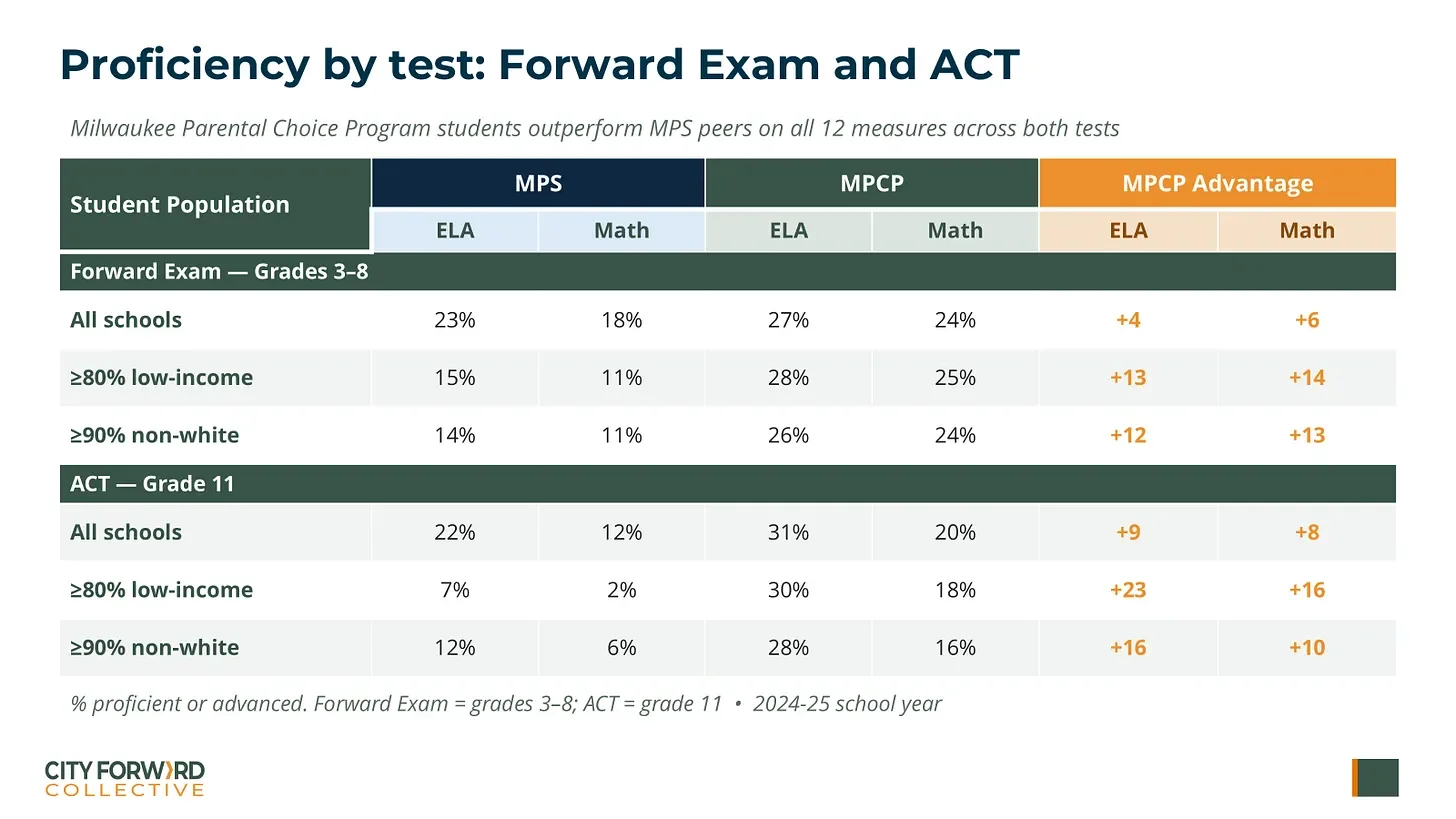
Here’s the reality: Ending the program doesn’t make 30,000 students disappear. It sends most of them into MPS instead, a district mired near the bottom of the nation in academic outcomes, and already carrying a looming half-billion-dollar deficit. Nobody proposing this has said where the classroom seats or the money for that many new students would come from.
It wouldn’t solve MPS’s money problem either. Choice programs account for less than 5% of what Wisconsin spends on K-12 education every year. It’s less than half of what it would cost just to raise the state’s special education reimbursement rate to a reasonable level – a genuine funding gap that actually deserves attention. And the state spends more than double what it spends on school choice, $1.2 billion, on the School Levy Tax Credit – a tax credit (1) that substantially benefits out-of-state owners of vacation homes. If Democrats want a real giveaway to the wealthy to campaign against, that’s the one.
CFC wants what our community is demanding: a serious conversation about accountability and transparency for every school in every sector, private, public charter, and district alike. We want to fix chronic absenteeism, shore up early literacy, and close the racial achievement gaps that have defined Milwaukee’s North Side for a generation. Those are the real priorities, and we’re ready to work on them with anyone who’s serious.
But you can’t have that conversation in good faith with people who hijack the term “accountability” for their extreme, ideological agenda. Every time “responsible sunset” gets floated, it swallows the actual work that needs doing, and it lets the candidates proposing it dodge the harder questions about what they’d actually do for Milwaukee’s schools.
Ask Hong, Barnes, or Roys what their plan is for the 30,000 kids they’d displace, and “sunset” stops sounding like a plan at all. Milwaukee families built this program and depend on it today. No press release or half-baked political talking point changes this, and no candidate who can’t answer that basic question deserves to be governor.
1 - Advocates across the spectrum, from the Badger Institute to the Association for Equity in Funding have pointed this out